

The Magic of Combining Strategies
One of the advantages of quantitative investing is that diversification can be engineered rather than left to chance.
I run several independent quant strategies. Within each one, I impose a strict rule: no single sector may account for more than 30% of the portfolio. That limit prevents any individual strategy from becoming overly concentrated. Still, a 30% allocation to one sector can be meaningful and a tad too high to my taste.
This is where the real magic begins.
Instead of relying on a single strategy, I combine four different strategies, each with its own stock-selection logic and sector profile, allocating 25% of the capital to each. The result is far more balanced than any of the individual strategies alone.
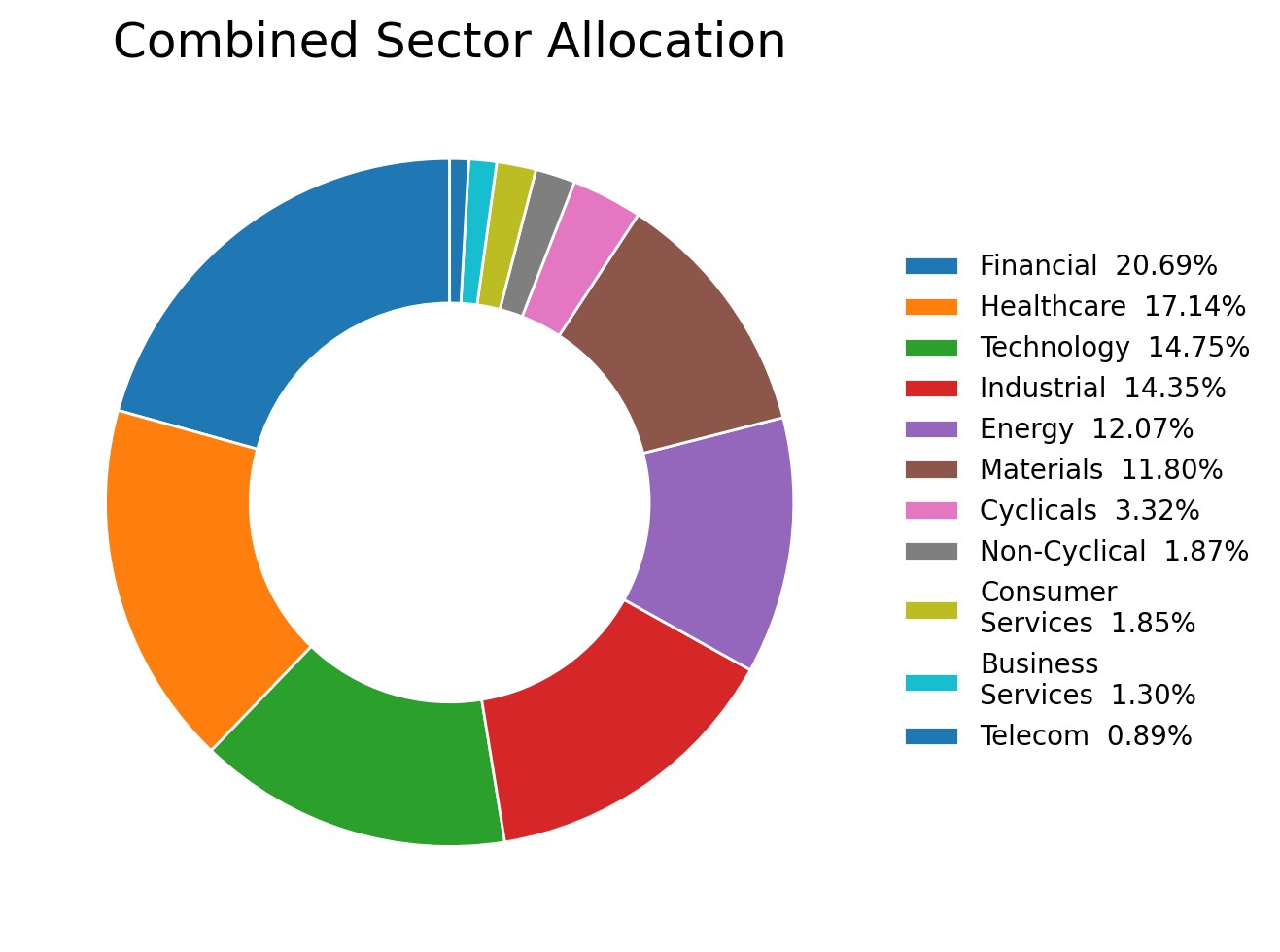
As the chart below illustrates, my current combined portfolio’s largest sector is Financials at just 20.69%, followed by Healthcare at 17.14%. No sector comes remotely close to the original 30% cap. The different strategies naturally offset one another, smoothing out sector concentrations without sacrificing their individual strengths.
The same phenomenon extends beyond sectors. The combined portfolio also achieves a healthier mix of market capitalizations while preserving its intended exposure to the mid and small- cap universe.
This is one of the closest things to a free lunch in investing: by combining multiple robust strategies that behave differently, you reduce concentration risk and build a more diversified portfolio without diluting the edge of the underlying models.
And yes, you guessed it: by combining the four strategies, volatility is reduced, as are the spells of underperformance vs. the benchmark.
Furthermore, I was recently asked whether I planned to incorporate AI or quantum computing stocks into my portfolios. My answer was very simple: if they offer a high probability of outperforming over the next three months, my system will find them, and they will automatically appear on my buy list.

That is one of the greatest advantages of a fully systematic, quantitative approach. I don’t have to spend my time trying to identify the next hidden gem or debating whether AI or quantum computing is the investment theme of the future. My job is simply to trust the process.
If AI or quantum stocks truly offer superior expected returns, my models will naturally allocate more capital to them within their respective sectors. If they don’t, they won’t make the cut. Rather than chasing narratives, I let my system do the work—and let the data make the decisions.
Sincerely,
Manuel Blay
Editor of thedowtheory.com